
Published on: July 09, 2026 | Reading Time: 11 minutes
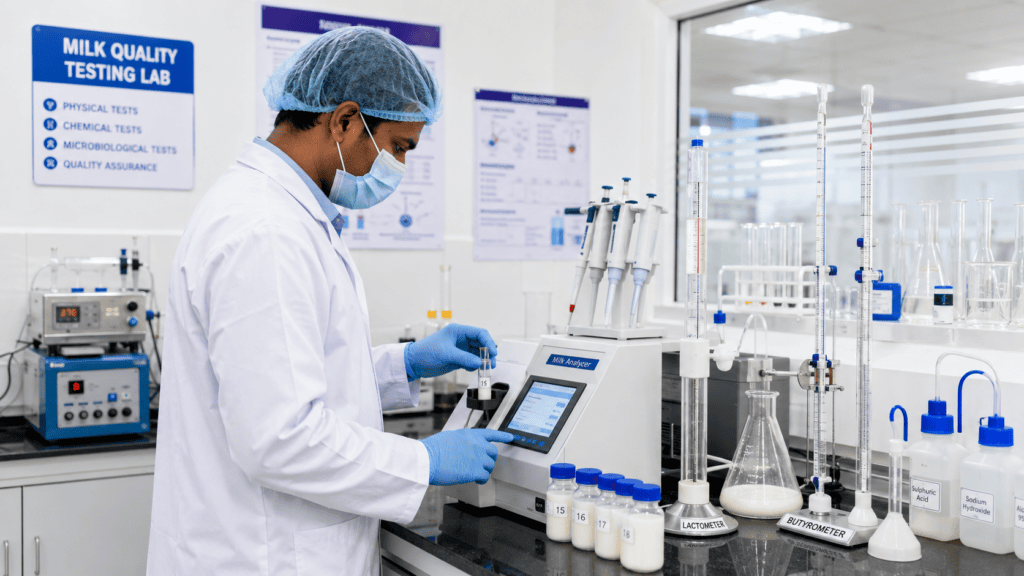
Milk quality determines your price, reputation, and business success. Poor quality milk means:
- ❌ Lower prices or rejection by buyers
- ❌ Loss of customer trust
- Health risks for consumers
- ❌ Reduced shelf life
High quality milk means:
- ✅ Premium pricing (₹5-10/liter extra)
- ✅ Loyal customers
- ✅ Better reputation
- ✅ Longer shelf life
In this comprehensive guide, we’ll cover:
- ✅ Key milk quality parameters
- ✅ Testing equipment and methods
- ✅ How to test fat, SNF, protein, and lactose
- ✅ Detecting adulteration (water, urea, detergent)
- ✅ Quality standards in India
- ✅ Improving milk quality on your farm
- ✅ Record-keeping and documentation
Master these techniques and ensure consistent high-quality milk that commands premium prices!
Key Milk Quality Parameters
1. Composition Parameters:
| Parameter | Cow Milk | Buffalo Milk | Importance |
|---|---|---|---|
| Fat | 3.5-5% | 6-8% | Price determination, richness |
| SNF (Solid Not Fat) | 8.5-9% | 9-10% | Nutritional value, quality |
| Protein | 3.2-3.5% | 3.5-4% | Nutritional quality |
| Lactose | 4.5-5% | 4.5-5% | Energy content |
| Water | 87-88% | 82-84% | Natural composition |
| Total Solids | 12-13% | 16-18% | Overall quality indicator |
2. Physical Parameters:
| Parameter | Standard | Testing Method |
|---|---|---|
| Color | White to creamy white | Visual inspection |
| Odor | Fresh, sweet, no off-odors | Smell test |
| Taste | Sweet, pleasant | Taste test (pasteurized only) |
| Temperature | Below 5°C (chilled) | Thermometer |
| Specific Gravity | 1.028-1.032 at 20°C | Lactometer |
3. Hygiene & Safety Parameters:
| Parameter | Acceptable Limit | Health Impact |
|---|---|---|
| Somatic Cell Count (SCC) | <400,000 cells/ml | Udder health indicator |
| Standard Plate Count (SPC) | <100,000 cfu/ml | Overall bacterial load |
| Coliform Count | <10 cfu/ml | Hygiene indicator |
| Antibiotic Residues | Nil | Drug resistance risk |
| Aflatoxin M1 | <0.5 ppb | Carcinogenic |
PART 1: TESTING EQUIPMENT & METHODS
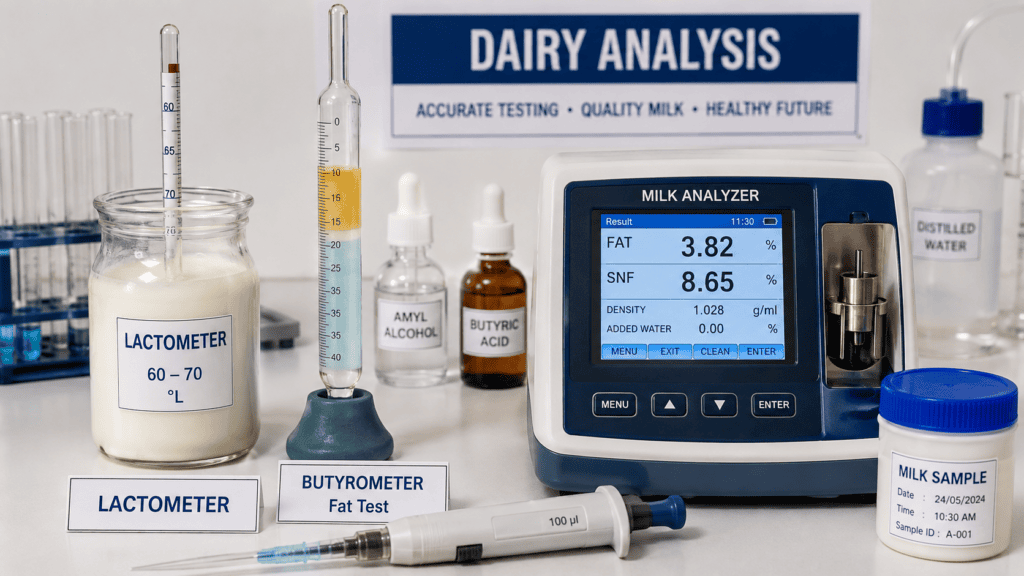
Essential Testing Equipment:
| Equipment | Purpose | Price Range | Accuracy |
|---|---|---|---|
| Lactometer | Specific gravity, water detection | ₹200-500 | ±0.5°L |
| Butyrometer (Gerber) | Fat percentage | ₹1,500-3,000 | ±0.1% |
| Milk Fat Tester (Digital) | Fat, SNF, protein, density | ₹40,000-1,50,000 | ±0.05% |
| Thermometer | Temperature measurement | ₹200-800 | ±0.1°C |
| pH Meter | Acidity check | 2,000-8,000 | ±0.01 pH |
| Alcohol Test Kit | Stability test | 500-1,500 | Qualitative |
| MBRT Test Kit | Bacterial quality | 1,000-2,500 | Semi-quantitative |
| Adulteration Test Kit | Detect water, urea, detergent | ₹2,000-5,000 | Qualitative |
Testing Methods – Step by Step
1. Lactometer Test (Water Adulteration)
| Step | Procedure | Reading |
|---|---|---|
| Step 1 | Fill lactometer jar with milk at 20°C (or note temperature) | – |
| Step 2 | Gently insert lactometer, let it float freely | – |
| Step 3 | Read at meniscus (surface level) | Normal: 28-32°L |
| Step 4 | Calculate: If <28°L, water added | Each degree = 1% water |
Formula: % Water Added = [(Normal Reading – Your Reading) Normal Reading] × 100
Example: If reading is 24°L instead of 30°L:
Water % = [(30-24) 30] × 100 = 20% water added!
2. Gerber Method (Fat Testing)
| Step | Procedure | Safety |
|---|---|---|
| Step 1 | Add 10ml sulfuric acid to butyrometer | ️ Wear gloves, goggles! |
| Step 2 | Carefully add 10.75ml milk | Don’t mix layers |
| Step 3 | Add 1ml amyl alcohol | Use pipette |
| Step 4 | Mix thoroughly (acid dissolves protein) | Invert gently |
| Step 5 | Centrifuge at 1100 RPM for 5 minutes | Balance tubes |
| Step 6 | Read fat percentage directly | Read at fat layer |
Result: Fat % reading directly on butyrometer scale
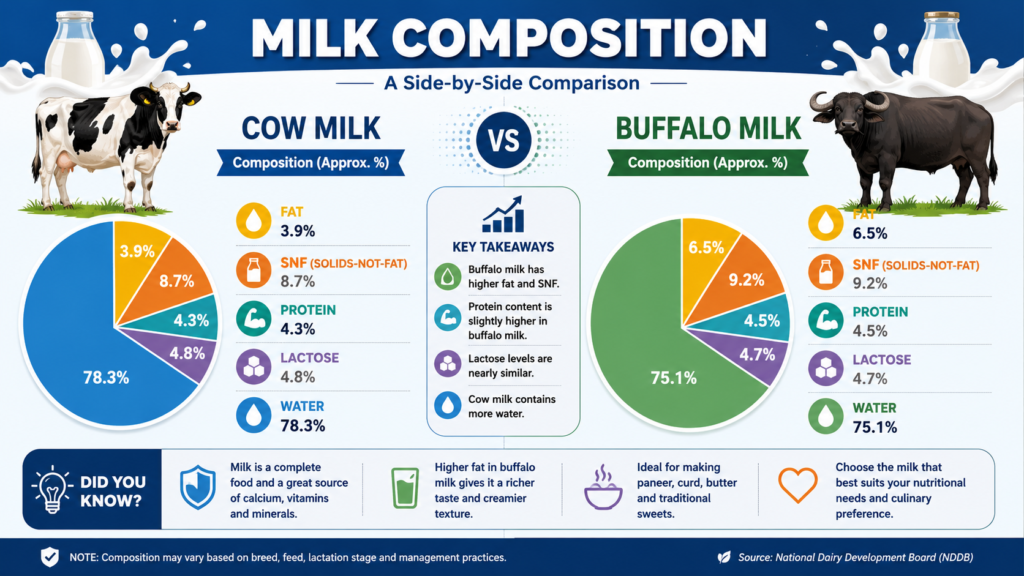
3. Digital Milk Tester (Fastest Method)
Modern digital testers give results in 30 seconds:
| Brand | Parameters Tested | Price | Accuracy |
|---|---|---|---|
| Lactoscan | Fat, SNF, protein, lactose, density, freezing point | ₹80,000-1,50,000 | ±0.05% |
| Ekomilk | Fat, SNF, protein, lactose, density | ₹60,000-1,20,000 | ±0.1% |
| MilkoScan | All parameters + somatic cells | ₹2-5 lakhs | ±0.03% |
| Indian Brands | Fat, SNF, protein, density | ₹40,000-80,000 | ±0.1% |
Advantages:
- ✅ Results in 30-60 seconds
- ✅ No chemicals required
- ✅ Multiple parameters at once
- ✅ Digital display, easy to read
- ✅ Data storage and printing
PART 2: DETECTING ADULTERATION
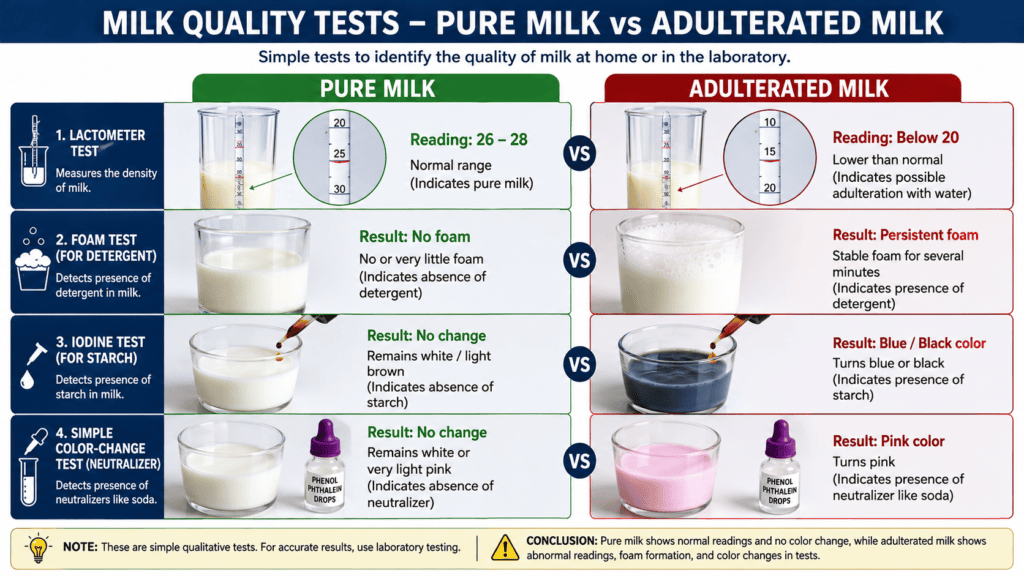
Common Adulterants & Detection:
| Adulterant | Why Added | Detection Test | Health Risk |
|---|---|---|---|
| Water | Increase volume | Lactometer reading <28°L | Reduces nutrition |
| Urea | Increase SNF | Urea test strip (turns pink) | Kidney damage |
| Detergent | Emulsify fat | Foam test (excessive foam) | Digestive issues |
| Starch | Increase SNF | Iodine test (blue color) | Diabetes risk |
| Salt | Mask water addition | Silver nitrate test (white ppt) | High BP |
| Sugar/Glucose | Increase lactometer reading | Barfoed’s test (red ppt) | Diabetes |
| Formalin | Preservative | H2SO4 test (violet ring) | Carcinogenic |
| Hydrogen Peroxide | Preservative | Starch-iodide test (blue) | Toxic |
Quick Adulteration Tests:
1. Water Detection (Lactometer):
- Normal: 28-32°L
- If <28°L: Water added
- % Water = [(30 – Your Reading) ÷ 30] × 100
2. Urea Detection:
- Add urea test strip to milk
- Wait 30 seconds
- Pink color = Urea present
3. Detergent Detection:
- Shake milk vigorously
- Excessive foam that persists = Detergent
- Normal milk: Foam disappears in 5 minutes
4. Starch Detection:
- Add 2-3 drops iodine solution
- Blue color = Starch present
- No color change = Pure milk
PART 3: QUALITY STANDARDS IN INDIA
FSSAI Standards (Food Safety Standards):
| Milk Type | Fat % (Min) | SNF % (Min) | Standard |
|---|---|---|---|
| Toned Milk | 3.0% | 8.5% | FSSAI |
| Double Toned Milk | 1.5% | 9.0% | FSSAI |
| Full Cream Milk | 6.0% | 9.0% | FSSAI |
| Standardized Milk | 4.5% | 8.5% | FSSAI |
| Buffalo Milk (Raw) | 6.0% | 9.0% | FSSAI |
| Cow Milk (Raw) | 3.5% | 8.5% | FSSAI |
Quality Grading:
| Grade | Fat % | SNF % | SPC (cfu/ml) | Price Premium |
|---|---|---|---|---|
| Excellent (A) | ≥5% (Cow), ≥7% (Buffalo) | ≥9% | <50,000 | +5-10/liter |
| Good (B) | 4-5% (Cow), 6-7% (Buffalo) | 8.5-9% | 50,000-100,000 | +₹2-5/liter |
| Average (C) | 3.5-4% (Cow), 5-6% (Buffalo) | 8-8.5% | 100,000-500,000 | Standard price |
| Poor (D) | <3.5% (Cow), <5% (Buffalo) | <8% | >500,000 | Rejected or -₹2-5/liter |
Improving Milk Quality on Your Farm
10 Proven Strategies:
| Strategy | Impact on Quality | Cost |
|---|---|---|
| 1. Clean Udder Before Milking | Reduces bacterial count by 80% | ₹100-200/month (disinfectant) |
| 2. Immediate Cooling (Below 5°C) | Prevents bacterial growth | BMC: ₹60,000-1.3 lakh |
| 3. Regular Mastitis Testing | Prevents high SCC milk | ₹500-1,000/month (test kits) |
| 4. Balanced Nutrition | Improves fat & SNF by 10-15% | ₹500-1,000/animal/month |
| 5. Clean Milking Equipment | Prevents contamination | ₹200-500/month (cleaners) |
| 6. Regular Vet Checkups | Early disease detection | ₹500-1,000/visit |
| 7. Proper Animal Hygiene | Reduces bacterial load | 300-500/month |
| 8. Avoid Antibiotic Milk | Prevents antibiotic residues | Test strips: ₹500-1,000 |
| 9. Filter Milk Immediately | Removes visible impurities | ₹50-100/filter |
| 10. Daily Quality Testing | Early problem detection | ₹1,000-2,000 (equipment) |
Record Keeping & Documentation
Daily Milk Quality Log:
| Date | Animal ID | Fat % | SNF % | Temp °C | Quality Grade |
|---|---|---|---|---|---|
| 01/07/26 | Cow-001 | 4.2% | 8.8% | 4.5°C | A (Excellent) |
| 01/07/26 | Buffalo-005 | 7.1% | 9.5% | 4.2°C | A (Excellent) |
Conclusion: Quality is Your Competitive Advantage!
Remember these golden rules:
- ✅ Test daily – Don’t guess, measure!
- ✅ Cool immediately – Below 5°C within 2 hours
- ✅ Maintain hygiene – Clean udder, clean equipment
- ✅ Document everything – Track trends, identify problems
- ✅ Never adulterate – Your reputation is priceless
High-quality milk = Premium price + Loyal customers + Business growth!
Need Help Tracking Milk Quality?
Manual record-keeping is time-consuming. PerfElite Dairy Management Software helps you:
- ✅ Record daily milk quality parameters
- ✅ Track fat, SNF trends per animal
- ✅ Generate quality reports
- ✅ Identify animals with quality issues
- ✅ Calculate price based on quality
- ✅ Maintain FSSAI compliance records
👉 Book Your FREE Demo Today and ensure consistent high-quality milk production!
⚠️ Disclaimer
The information provided in this article is for educational purposes only. Milk quality standards may vary by region and buyer requirements. We recommend regular testing by certified laboratories for commercial operations. Always follow FSSAI guidelines and local regulations. PerfElite is not responsible for any losses or damages resulting from the use of this information.
Frequently Asked Questions (FAQs)
Q1: What is the ideal fat and SNF percentage for cow milk?
A: For cow milk: Fat 3.5-5%, SNF 8.5-9%. For buffalo milk: Fat 6-8%, SNF 9-10%. Higher percentages command premium prices.
Q2: How do I test milk quality at home?
A: Basic tests you can do: 1) Lactometer for water detection (₹200-500), 2) Visual inspection for color/odor, 3) Alcohol test for stability, 4) Boiling test for acidity. For accurate fat/SNF testing, use digital milk tester or send to lab.
Q3: What causes low fat in milk?
A: Common causes: 1) Poor nutrition (lack of green fodder), 2) Advanced lactation stage, 3) Heat stress, 4) Mastitis, 5) Breed genetics. Solution: Improve diet with quality fodder and concentrates.
Q4: How long can raw milk be stored?
A: At room temperature: 2-4 hours only. Refrigerated (4°C): 24-48 hours. With bulk milk cooler (4°C): 48-72 hours. Always cool immediately after milking!
Q5: What is SNF in milk?
A: SNF (Solid Not Fat) includes protein, lactose, minerals, and vitamins. Normal range: 8.5-9% for cow milk, 9-10% for buffalo milk. Low SNF indicates water adulteration or poor nutrition.
Q6: How to detect water in milk?
A: Use lactometer: Normal reading 28-32°L. If <28°L, water is added. Each degree below 28 indicates approximately 1% water addition.
Q7: Which is better – manual or digital milk testing?
A: Digital testers are faster (30 seconds vs 10 minutes), more accurate (±0.05% vs ±0.1%), and test multiple parameters at once. However, they’re expensive (₹40,000-1,50,000). For small farms, manual Gerber method is sufficient.
Q8: What is the price difference between good and poor quality milk?
A: Excellent quality (Grade A): ₹50-60/liter. Good quality (Grade B): ₹45-50/liter. Average quality (Grade C): ₹40-45/liter. Poor quality (Grade D): ₹35-40/liter or rejected. That’s a ₹10-20/liter difference!
About the Author: This comprehensive milk quality guide is brought to you by PerfElite Dairy Management Software – helping dairy farmers across India maintain consistent high-quality milk production and maximize profitability.
Related Articles: