
Published on: July 09, 2026 | Reading Time: 11 minutes
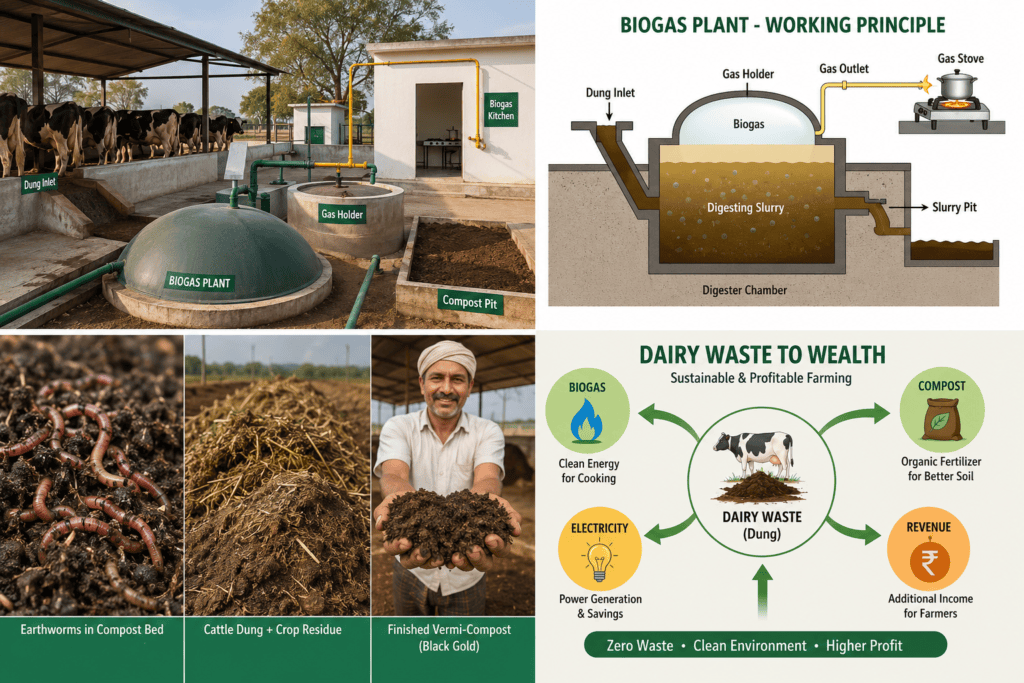
Dairy farm waste is not a problem – it’s an opportunity!
Every day, a single dairy animal produces:
- ❌ 25-35 kg of manure (dung + urine)
- ❌ 50-80 liters of wastewater
- ❌ 2-3 kg of spoiled feed
For a 10-animal farm, that’s 300+ kg of waste daily! But here’s the good news:
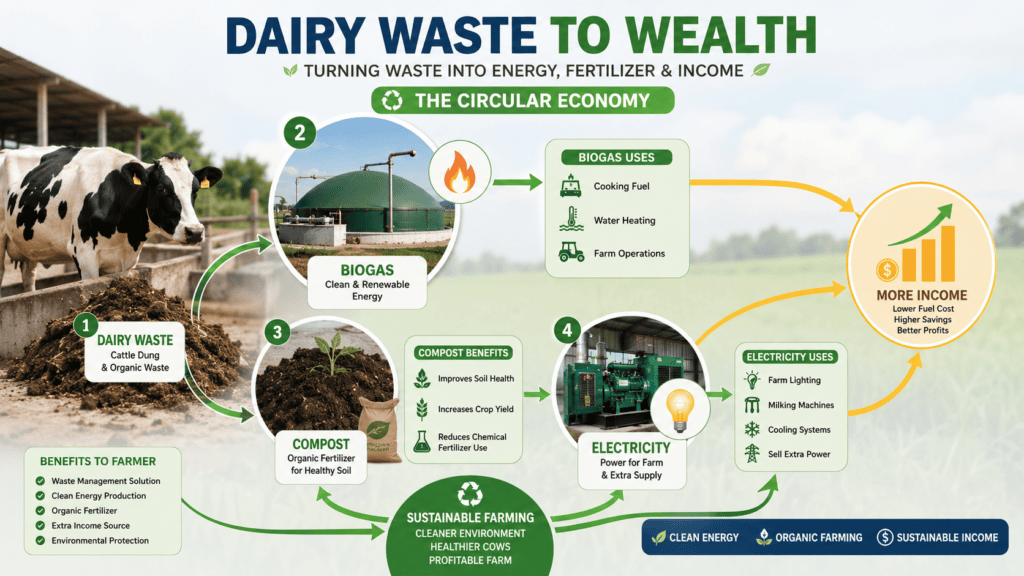
This “waste” can become:
- ✅ Free electricity (biogas)
- ✅ Organic fertilizer (compost)
- ✅ ₹50,000-2,00,000 annual income
- ✅ Cleaner environment
- ✅ Disease-free farm
In this comprehensive guide, we’ll cover:
- ✅ Types of dairy farm waste
- ✅ Biogas plant setup (cost, capacity, ROI)
- ✅ Composting methods (vermi-compost, aerobic)
- ✅ Wastewater management
- ✅ Government subsidies (40-60%)
- ✅ Environmental benefits
- ✅ Complete cost-benefit analysis
Transform your waste into wealth and achieve zero-waste dairy farming!
Understanding Dairy Farm Waste
Types of Waste Generated:
| Waste Type | Quantity/Animal/Day | Management Method | Value |
|---|---|---|---|
| Dung (Manure) | 15-20 kg | Biogas, composting | ₹500-1,000/month |
| Urine | 10-15 liters | Jeevamrut, liquid fertilizer | ₹200-400/month |
| Wastewater | 50-80 liters | Settlement tank, reuse | Water conservation |
| Feed Wastage | 2-3 kg | Composting | ₹100-200/month |
| Bedding Material | 3-5 kg | Composting | 150-300/month |
| Total Per Animal | 80-120 kg/day | 100% utilization | ₹950-1,900/month |
PART 1: BIOGAS PLANT – FREE ELECTRICITY FROM WASTE
What is Biogas?
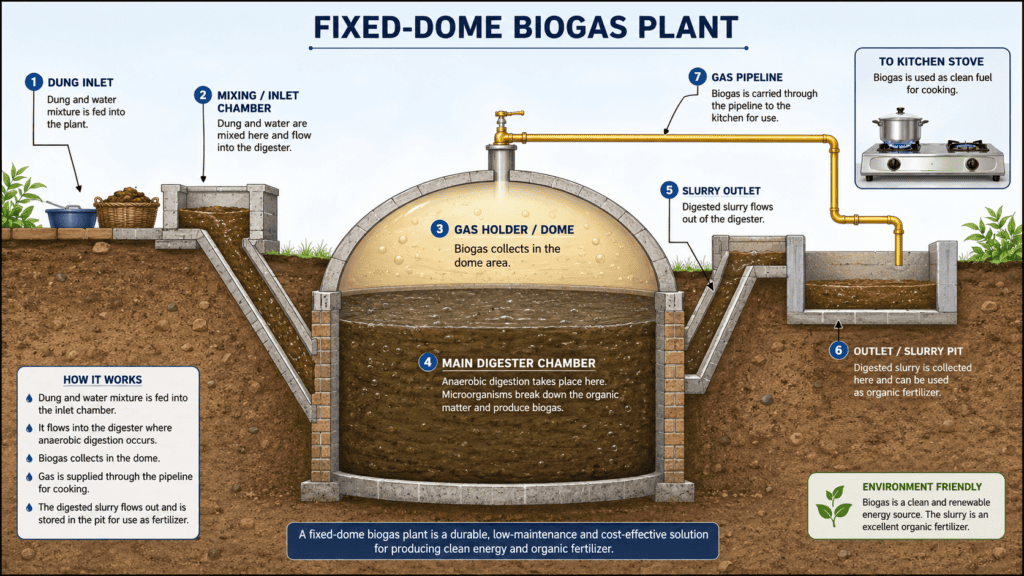
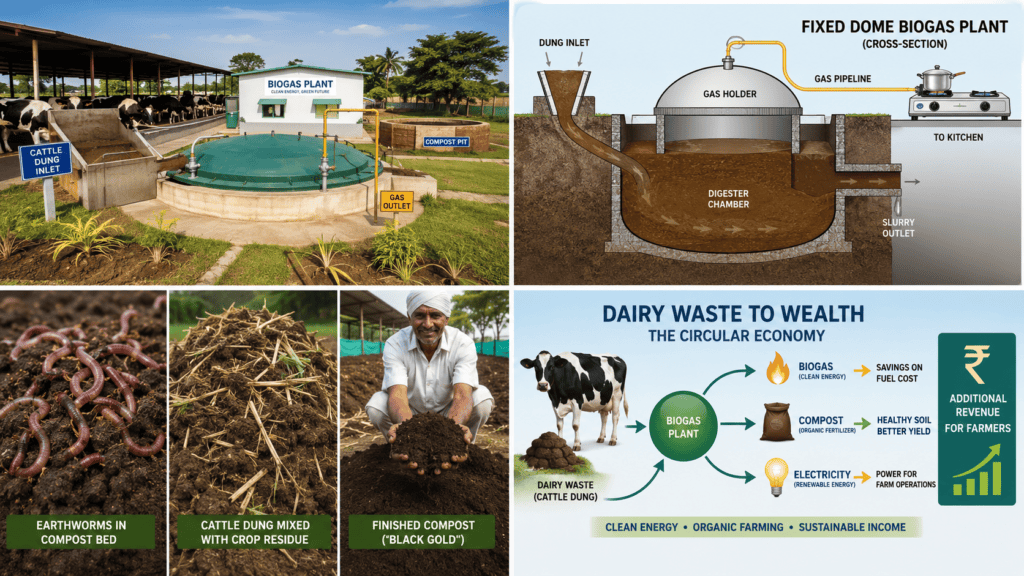
Biogas is a renewable energy source produced by anaerobic decomposition (without oxygen) of organic matter like cattle dung. It contains:
| Component | Percentage | Use |
|---|---|---|
| Methane (CH₄) | 55-65% | Main fuel component |
| Carbon Dioxide (CO₂) | 35-40% | Byproduct |
| Hydrogen Sulfide (H₂S) | 1-2% | Removed during purification |
| Other Gases | 1-2% | Nitrogen, Oxygen, Hydrogen |
Biogas Plant Capacity & Cost:
| Plant Size | Animals Required | Gas Production | Cost (Without Subsidy) | Cost (With 40% Subsidy) |
|---|---|---|---|---|
| 1 m³ (Small) | 2-3 animals | 1 m³/day (35 cft) | ₹25,000-35,000 | ₹15,000-21,000 |
| 2 m³ (Medium) | 4-6 animals | 2 m³/day (70 cft) | ₹40,000-55,000 | ₹24,000-33,000 |
| 3 m³ (Large) | 6-10 animals | 3 m³/day (105 cft) | ₹60,000-80,000 | ₹36,000-48,000 |
| 5 m³ (Commercial) | 10-15 animals | 5 m³/day (175 cft) | ₹90,000-1,20,000 | 54,000-72,000 |
| 10 m³ (Industrial) | 20-30 animals | 10 m³/day (350 cft) | ₹1.5-2 lakhs | ₹90,000-1.2 lakhs |
What Can You Do with Biogas?
| Application | Gas Required | Savings |
|---|---|---|
| Cooking (Family of 4) | 0.5-1 m³/day | ₹800-1,200/month (LPG savings) |
| Electricity Generation | 1 m³ = 1.5 kWh | ₹200-300/month (electricity bill) |
| Water Heating | 0.3-0.5 m³/day | ₹500-800/month |
| Milk Cooling (Small BMC) | 2-3 m³/day | 1,500-2,500/month |
| Lighting (Biogas Lamp) | 0.1 m³/hour | ₹200-400/month |
ROI Calculation for 3 m³ Biogas Plant:
| Parameter | Details |
|---|---|
| Plant Cost (with subsidy) | 36,000-48,000 |
| Monthly Savings | ₹2,500-3,500 |
| – LPG replacement | ₹1,000 |
| – Electricity savings | ₹800 |
| – Compost sales | ₹700-1,700 |
| Annual Savings | ₹30,000-42,000 |
| Payback Period | 12-18 months |
| 10-Year Savings | ₹3,00,000-4,20,000! |
Biogas Plant Types:
| Type | Best For | Cost | Advantages |
|---|---|---|---|
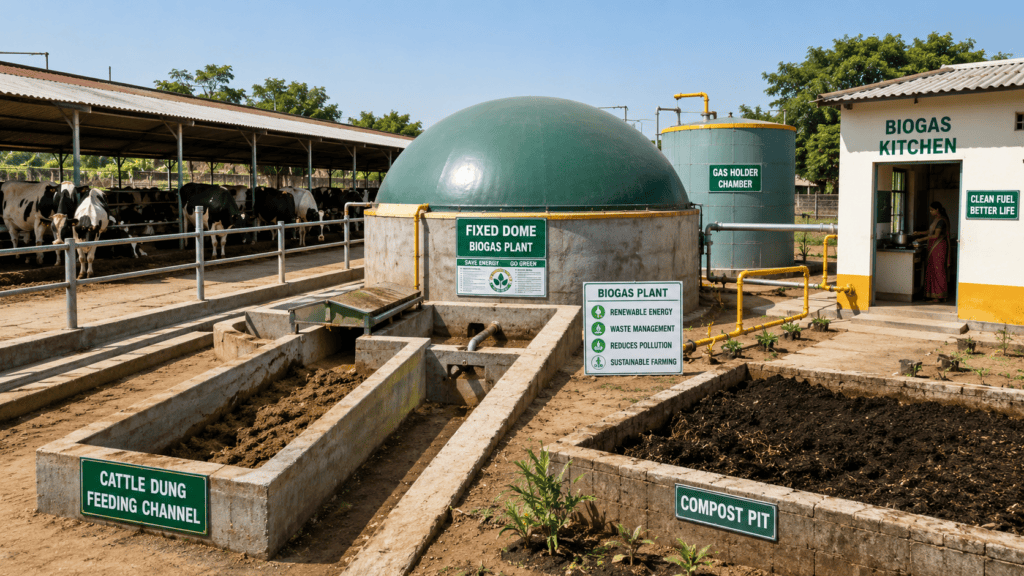
| Fixed Dome (Deenbandhu) | Small-medium farms | ₹25,000-60,000 | Low cost, underground, long life (20+ years) |
| Floating Drum (KVIC) | All farm sizes | ₹35,000-80,000 | Constant pressure, easy to operate |
| Bag Type (Flexible) | Temporary/rented land | ₹20,000-40,000 | Portable, easy installation |
| Prefabricated (FRP) | Quick installation | ₹40,000-1,00,000 | Factory-made, 1-day installation |
PART 2: COMPOSTING – ORGANIC GOLD FROM WASTE
Composting Methods:
1. Vermi-Compost (Best Quality):
| Parameter | Details |
|---|---|
| Process Time | 45-60 days |
| Earthworm Species | Eisenia fetida (Red Wiggler) |
| Input Required | Dung + crop residue (3:1 ratio) |
| Output | 60% of input weight |
| Investment (10 animals) | ₹15,000-25,000 (shed + worms) |
| Monthly Production | 300-400 kg |
| Selling Price | ₹8-15/kg |
| Monthly Income | ₹2,400-6,000 |
| Annual Income | ₹28,800-72,000! |
2. Aerobic Composting (Traditional):
| Parameter | Details |
|---|---|
| Process Time | 90-120 days |
| Method | Windrow/pit composting |
| Turning Frequency | Every 7-10 days |
| Investment | ₹5,000-10,000 (minimal) |
| Monthly Production | 400-500 kg |
| Selling Price | ₹3-5/kg |
| Monthly Income | ₹1,200-2,500 |
3. Compost Turner Machine:
| Type | Capacity | Price | Time Saved |
|---|---|---|---|
| Manual Turner | 2-3 tons/day | ₹15,000-25,000 | 50% labor |
| Self-Propelled | 10-15 tons/day | 80,000-1.5 lakhs | 80% labor |
| Hydraulic Turner | 20-30 tons/day | ₹2-4 lakhs | 90% labor |
PART 3: WASTEWATER MANAGEMENT
Wastewater Treatment System:
| Component | Function | Cost |
|---|---|---|
| Settlement Tank | Solids separation | 10,000-20,000 |
| Grease Trap | Fat/oil removal | ₹5,000-10,000 |
| Bio-Digester | Organic matter breakdown | ₹20,000-40,000 |
| Constructed Wetland | Final polishing | ₹15,000-30,000 |
Water Reuse Options:
- ✅ Irrigation of fodder crops
- ✅ Shed cleaning (after treatment)
- ✅ Gardening/landscaping
- ✅ Recharging groundwater
GOVERNMENT SUBSIDIES & SCHEMES
Available Subsidies:
| Scheme | Subsidy % | Max Amount | Eligibility |
|---|---|---|---|
| NABARD Biogas | 40-60% | ₹25,000-50,000 | All farmers |
| MNRE Biogas | 40-50% | ₹20,000-40,000 | Rural households |
| State Dairy Dev. | 33-50% | ₹15,000-30,000 | Dairy farmers |
| Vermi-Compost | 33-50% | ₹10,000-20,000 | All farmers |
| Compost Turner | 40-50% | ₹20,000-40,000 | Medium-large farms |
How to Apply:
- Step 1: Visit district Agriculture/Horticulture office
- Step 2: Get application form for biogas/compost scheme
- Step 3: Submit documents:
- Aadhaar card
- Land documents
- Dairy registration
- Bank account details
- Quotation from approved vendor
- Step 4: Get technical feasibility approved
- Step 5: Install plant after approval
- Step 6: Inspection by officials
- Step 7: Subsidy credited to bank account
Environmental Benefits
| Benefit | Impact |
|---|---|
| Greenhouse Gas Reduction | 1 m³ biogas = 2.5 kg CO₂ reduction |
| Deforestation Prevention | 1 m³ biogas = 10 kg firewood saved |
| Soil Health Improvement | Compost increases soil fertility 40% |
| Water Conservation | Treated water reuse saves 50% freshwater |
| Disease Reduction | Proper waste disposal reduces pathogens 90% |
Total Waste-to-Wealth ROI (10 Animals)
| Revenue Source | Monthly Income | Annual Income |
|---|---|---|
| Biogas (LPG/Electricity savings) | ₹2,500-3,500 | ₹30,000-42,000 |
| Vermi-compost sales | ₹2,400-6,000 | ₹28,800-72,000 |
| Liquid fertilizer (Jeevamrut) | 500-1,000 | 6,000-12,000 |
| Reduced fertilizer cost (own farm) | ₹1,000-2,000 | ₹12,000-24,000 |
| TOTAL ANNUAL BENEFIT | ₹76,800-1,50,000! | |
Conclusion: Waste is Wealth!
With proper waste management:
- ✅ Zero waste – 100% utilization
- ✅ Free energy – Biogas for cooking/electricity
- ✅ Organic fertilizer – Improve soil health
- ✅ Additional income – ₹75,000-1,50,000/year
- ✅ Clean environment – Disease-free farm
- ✅ Government support – 40-60% subsidy
Start your waste-to-wealth journey today!
Need Help Managing Your Dairy Farm?
Track waste production, biogas generation, and compost sales with PerfElite Dairy Management Software:
- ✅ Waste production tracking per animal
- ✅ Biogas generation monitoring
- ✅ Compost inventory management
- ✅ Revenue tracking from waste products
- ✅ Subsidy application tracking
👉 Book Your FREE Demo Today and turn your waste into profit!
⚠️ Disclaimer
The information provided in this article is for educational purposes only. Biogas plant costs and subsidies may vary by location and government policies. We recommend consulting with certified biogas installers and local agriculture departments for accurate information. PerfElite is not responsible for any losses or damages resulting from the use of this information.
Frequently Asked Questions (FAQs)
Q1: How much dung is required for 1 m³ biogas?
A: Approximately 25-30 kg fresh cattle dung (from 2-3 animals) mixed with equal water produces 1 m³ biogas per day.
Q2: Can I use only buffalo dung for biogas?
A: Yes! Buffalo dung has higher methane potential than cow dung. You’ll get 10-15% more gas from buffalo dung.
Q3: How long does a biogas plant last?
A: Fixed dome plants last 20-25 years, floating drum plants last 15-20 years with proper maintenance.
Q4: Can biogas run a generator?
A: Yes! 1 m³ biogas generates 1.5 kWh electricity. You need a biogas generator set (available for ₹40,000-1,00,000).
Q5: What is the best composting method?
A: Vermi-compost gives highest quality (8-15/kg) and faster results (45-60 days). Aerobic composting is cheaper but slower (90-120 days).
Q6: How do I get biogas subsidy?
A: Apply through NABARD, MNRE, or state dairy development board. Submit application with quotations, get technical approval, install plant, and receive 40-60% subsidy in your bank account.
Q7: Can I sell excess biogas?
A: Currently, selling biogas is not common. However, you can use it for cooking, electricity generation, or water heating. Excess can be stored in gas holders for later use.
Q8: How much compost can I produce from 10 animals?
A: From 10 animals (300 kg dung/day), you can produce: Vermi-compost: 180 kg/day (5.4 tons/month), Aerobic compost: 150 kg/day (4.5 tons/month).
About the Author: This comprehensive waste management guide is brought to you by PerfElite Dairy Management Software – helping dairy farmers across India achieve sustainable, zero-waste farming and maximize profitability.
Related Articles: