
Published on: July 09, 2026 | Reading Time: 12 minutes
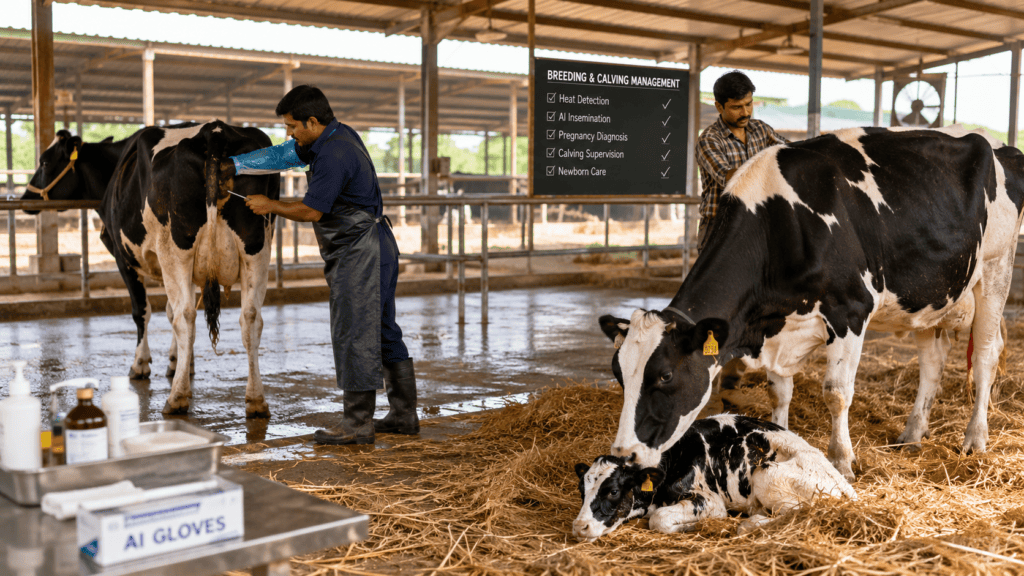
Breeding and calving management is the foundation of a profitable dairy business. Get it right, and you’ll have:
- ✅ Regular calving every 12-13 months
- ✅ Consistent milk production year-round
- ✅ Healthy calves for herd replacement
- ✅ Maximum profitability per animal
Get it wrong, and you’ll face:
- ❌ Long calving intervals (15-18 months)
- ❌ Extended dry periods
- ❌ Reduced lifetime milk production
- ❌ Significant financial losses
In this comprehensive guide, we’ll cover:
- ✅ Understanding the breeding cycle
- ✅ Heat detection methods (95% accuracy)
- ✅ Artificial insemination vs natural breeding
- ✅ Pregnancy diagnosis and care
- ✅ Calving preparation and process
- ✅ Post-calving care for cow and calf
- ✅ Common breeding problems and solutions
- ✅ Breeding calendar and record-keeping
Master these techniques and achieve 90%+ conception rates with regular calving intervals!
Understanding the Dairy Animal Reproductive Cycle
Key Reproductive Parameters:
| Parameter | Cow | Buffalo | Importance |
|---|---|---|---|
| Estrous Cycle | 21 days (18-24) | 21 days (18-24) | Heat cycle length |
| Heat Duration | 12-18 hours | 12-24 hours | Breeding window |
| Gestation Period | 280-285 days | 300-315 days | Pregnancy length |
| First Heat After Calving | 45-60 days | 60-90 days | Re-breeding time |
| Calving Interval | 12-13 months (ideal) | 13-15 months | Profitability indicator |
| Dry Period | 60 days (essential) | 60-75 days | Udder recovery |
Key Insight: Every day of delayed conception costs you ₹100-150 in lost milk production!
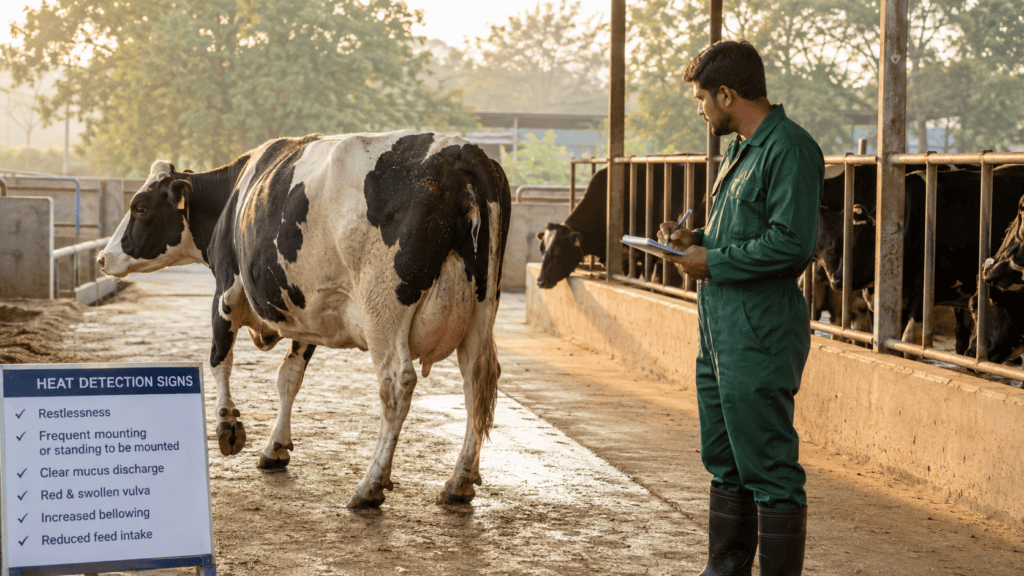
PART 1: HEAT DETECTION (सबसे Important!)
Proper heat detection is 80% of successful breeding. Miss the heat, and you lose 21 days!
Signs of Heat (Estrus):
| Sign | Description | Reliability |
|---|---|---|
| Standing to be Mounted | Animal stands still when mounted by others | ⭐⭐⭐⭐⭐ (Most reliable) |
| Mucus Discharge | Clear, stringy mucus from vulva | ⭐⭐⭐⭐ |
| Restlessness | Frequent urination, bellowing, pawing | ⭐⭐⭐ |
| Reduced Milk Yield | 10-20% drop in production | ⭐⭐⭐ |
| Swollen Vulva | Redness and swelling | ⭐⭐ |
| Chin Resting | Other animals rest chin on her back | ⭐⭐⭐⭐ |
Heat Detection Schedule:
| Observation Time | Duration | Detection Rate |
|---|---|---|
| Early Morning | 5:00-7:00 AM (30 min) | 40% of heats |
| Mid-Day | 12:00-2:00 PM (20 min) | 20% of heats |
| Evening | 6:00-8:00 PM (30 min) | 40% of heats |
| Total Daily Observation | 80 minutes | 90-95% detection |
Pro Tip: Observe animals when they’re relaxed – not during feeding or milking!
Heat Detection Aids:
| Method | How It Works | Cost | Accuracy |
|---|---|---|---|
| Chalk/Rub-on Paint | Apply on tailhead – rubs off when mounted | ₹200-300 | 80-85% |
| Heat Detector Patches | Color change when mounted | ₹50-100/patch | 85-90% |
| Pedometers | Detect increased activity | 2,000-5,000 | 90-95% |
| Teaser Bull/Animal | Vasectomized bull identifies heat | ₹30,000-50,000 | 95%+ |
PART 2: BREEDING METHODS
Artificial Insemination (AI) vs Natural Service:
| Factor | Artificial Insemination | Natural Service |
|---|---|---|
| Cost per Service | ₹200-500 | ₹500-1,000 (bull maintenance) |
| Genetic Improvement | Excellent (proven bulls) | Limited (local bull) |
| Disease Risk | Very low | High (STD transmission) |
| Conception Rate | 60-70% (with good AI) | 70-80% |
| Safety | Very safe | Dangerous (bull attacks) |
| Record Keeping | Easy (documented) | Difficult |
| Recommendation | ✅ BEST for most farms | Only for large herds (50+ animals) |
Optimal Timing for AI:
| Heat Observed | AI Timing | Conception Rate |
|---|---|---|
| Morning (6 AM – 12 PM) | Same day evening (6-8 PM) | 65-70% |
| Evening (6 PM – 12 AM) | Next day morning (6-8 AM) | 65-70% |
| Golden Rule: | AI 12 hours AFTER heat detection | |
PART 3: PREGNANCY DIAGNOSIS & CARE
Pregnancy Diagnosis Methods:
| Method | When | Accuracy | Cost |
|---|---|---|---|
| Rectal Palpation | 45-60 days post-AI | 90-95% | ₹100-200 |
| Ultrasound | 30-35 days post-AI | 98-99% | ₹300-500 |
| Blood Test (PAG) | 28-32 days post-AI | 95-98% | ₹200-400 |
| Milk Progesterone | 21-24 days post-AI | 85-90% | ₹150-300 |
Recommendation: Confirm pregnancy at 45-60 days via rectal palpation (most economical and reliable)
Pregnant Animal Care:
First 6 Months:
- ✅ Normal feeding (maintenance + production)
- ✅ Regular exercise
- ✅ Continue milking
- ✅ Vaccination as per schedule
Last 3 Months (Critical Period):
| Nutrient | Increase | Purpose |
|---|---|---|
| Energy (TDN) | +20-30% | Fetal growth (70% growth in last 3 months!) |
| Protein (DCP) | +15-20% | Udder development, colostrum |
| Calcium | +50% | Bone development, prevent milk fever |
| Phosphorus | +40% | Fetal skeleton |
| Vitamin A, D, E | Supplement | Immunity, calf health |
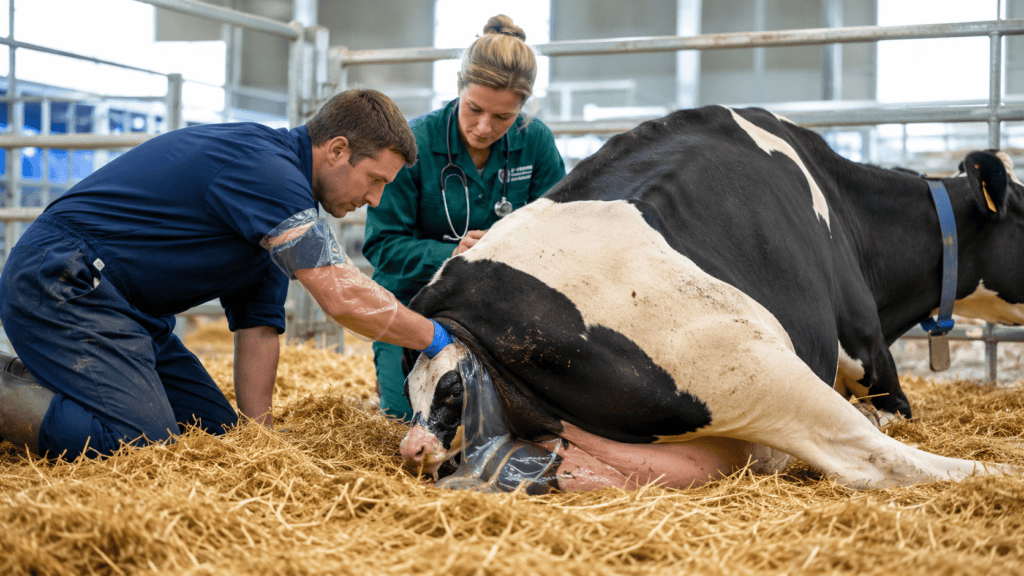
PART 4: CALVING MANAGEMENT
Signs of Approaching Calving:
| Time Before Calving | Signs |
|---|---|
| 2-3 Weeks Before | Udder fills, teats wax up |
| 1-2 Days Before | Vulva swells, mucus plug discharged, tail head relaxes |
| 12-24 Hours Before | Restlessness, frequent urination, isolation from herd |
| Calving Starts | Water bag appears, straining begins |
Calving Process – Stage by Stage:
| Stage | Duration | What Happens | Your Action |
|---|---|---|---|
| Stage 1: Preparation | 2-6 hours | Cervix dilates, water bag forms | Observe from distance, prepare clean area |
| Stage 2: Delivery | 30 min – 2 hours | Calf expelled | Assist if needed (see below) |
| Stage 3: Afterbirth | 2-8 hours | Placenta expelled | Check if complete, dispose properly |
When to Assist Calving:
- ✅ Water bag broken but no progress in 1 hour
- ✅ Calf visible but stuck
- ✅ Abnormal presentation (legs back, head back, breech)
- ✅ Excessive straining with no progress
How to Assist (Step-by-Step):
- Prepare:
- Wash hands and animal’s vulva thoroughly
- Use lubricant (liquid soap/glycerine)
- Wear gloves if available
- Check Position:
- Normal: Two front legs + head (diving position)
- If abnormal, gently push calf back and reposition
- Apply Traction:
- Use calving chains/ropes on legs
- Pull DOWNWARD (following pelvic curve)
- Pull only during cow’s straining
- Two people maximum force
- After Delivery:
- Clear calf’s nose/mouth of mucus
- Stimulate breathing (rub vigorously)
- Dip navel in iodine solution
- Ensure calf gets colostrum within 2 hours
⚠️ Call Veterinarian If:
- ❌ No progress after 2 hours of assisted pulling
- ❌ Calf too large (fetopelvic disproportion)
- ❌ Uterine torsion suspected
- ❌ Excessive bleeding
PART 5: POST-CALVING CARE
Immediate Care for Cow (First 24 Hours):
| Action | Timing | Purpose |
|---|---|---|
| Provide warm water with jaggery/salt | Immediately after calving | Energy, prevent dehydration |
| Check placenta expulsion | Within 6-8 hours | Prevent infection |
| Administer calcium bolus | Within 12 hours | Prevent milk fever |
| Give NSAIDs (pain relief) | Within 24 hours | Reduce pain, improve appetite |
| Offer fresh green fodder | First day | Stimulate appetite |
Care for Newborn Calf:
| Action | Timing | Critical For |
|---|---|---|
| Colostrum Feeding | Within 2 hours (ESSENTIAL!) | Immunity (antibodies) |
| Quantity | 10% of body weight (3-4L) | First 24 hours total |
| Navel Disinfection | Immediately after birth | Prevent joint ill, navel infection |
| Vitamin E/Selenium | Within 24 hours | Prevent white muscle disease |
| Separate Pen | First 3-7 days | Monitor health, bonding |
⚠️ Colostrum is CRITICAL: Calves are born with ZERO immunity. Colostrum provides antibodies that protect against diseases for first 3-4 months!
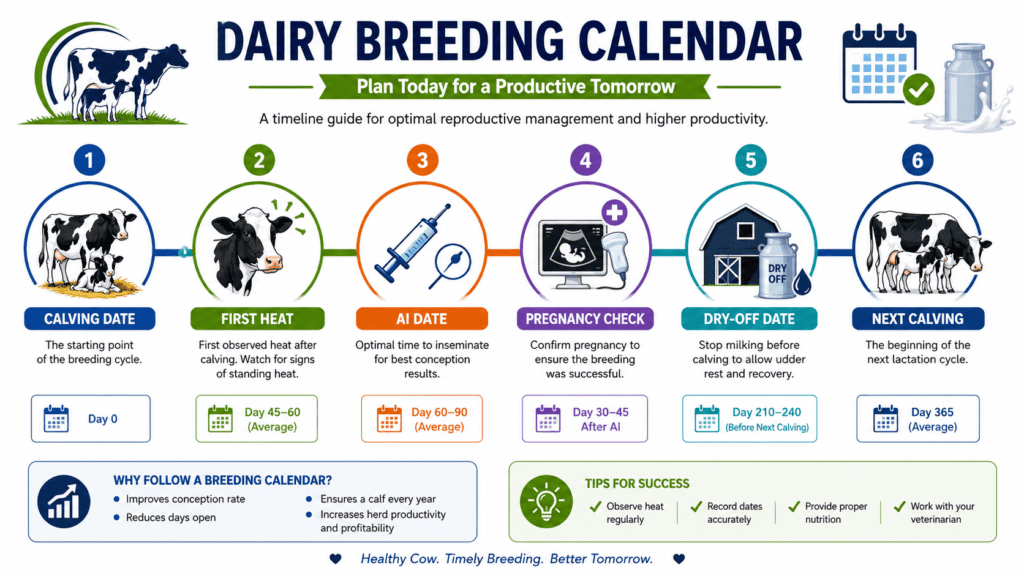
BREEDING RECORDS & CALENDAR
Essential Records to Maintain:
| Record Type | Information | Why Important |
|---|---|---|
| Heat Detection Log | Date, time, signs observed | Predict next heat, breeding timing |
| AI/Breeding Record | Date, bull/semen ID, technician | Calculate due date, track conception |
| Pregnancy Check | Date, method, result, fetus age | Confirm pregnancy, plan dry-off |
| Calving Record | Date, time, calf details, complications | Future breeding decisions, health tracking |
| Dry-off Date | Expected and actual dry date | Ensure 60-day dry period |
Breeding Calendar Example:
For Cow Calved on January 1, 2026:
| Event | Expected Date | Action Required |
|---|---|---|
| Calving | January 1, 2026 | Record, colostrum feeding |
| First Heat | Feb 15-25, 2026 (45-60 days) | Observe carefully, don’t breed first heat |
| Breeding (AI) | March 10-20, 2026 (60-90 days) | AI 12 hours after heat detection |
| Pregnancy Check | May 1-10, 2026 (45-60 days post-AI) | Rectal palpation by vet |
| Expected Calving | December 15-20, 2026 | Prepare calving area |
| Dry-off Date | October 15-20, 2026 (60 days before) | Stop milking, dry cow treatment |
Common Breeding Problems & Solutions
| Problem | Causes | Solutions |
|---|---|---|
| Silent Heat (No visible signs) | Poor nutrition, obesity, stress, mineral deficiency | Improve nutrition, use teaser animal, rectal exam |
| Repeat Breeding (Multiple AI failures) | Uterine infection, poor AI technique, wrong timing | Vet examination, improve heat detection, check semen quality |
| Abortion | Infectious diseases, trauma, nutritional deficiency | Vaccination, proper nutrition, avoid stress, vet care |
| Retained Placenta (Afterbirth not expelled) | Calcium deficiency, difficult calving, infection | Don’t pull manually, call vet, antibiotic treatment |
| Dystocia (Difficult calving) | Large calf, small pelvis, abnormal presentation | Assist carefully, call vet if no progress, C-section if needed |
Conclusion: Breeding is the Engine of Your Dairy!
Remember these golden rules:
- ✅ Observe for heat 3 times daily – 80% of success
- ✅ AI 12 hours after heat detection – optimal timing
- ✅ Confirm pregnancy at 45-60 days – early detection
- ✅ Maintain 60-day dry period – essential for udder health
- ✅ Aim for 12-13 month calving interval – maximum profitability
- ✅ Keep detailed records – track and improve
Every day of delayed conception costs ₹100-150! Invest time in proper breeding management – it’s the highest ROI activity on your farm.
Need Help Managing Your Dairy Breeding Program?
Tracking breeding, pregnancy, and calving dates manually is challenging. PerfElite Dairy Management Software helps you:
- ✅ Automatic heat detection reminders
- ✅ AI date tracking and due date calculation
- ✅ Pregnancy check alerts
- ✅ Dry-off date notifications
- ✅ Complete breeding history per animal
- ✅ Calving interval analysis
Book Your FREE Demo Today and optimize your breeding program for maximum productivity!
⚠️ Disclaimer
The information provided in this article is for educational purposes only. Breeding and calving should be performed under veterinary supervision. Actual results may vary based on animal health, breed, management practices, and local conditions. We recommend consulting with a qualified veterinarian for all breeding and calving procedures. PerfElite is not responsible for any losses or damages resulting from the use of this information.
Frequently Asked Questions (FAQs)
Q1: When should I breed my cow/buffalo after calving?
A: Wait 60-90 days after calving before breeding. First heat (45-60 days) should be observed but not bred. Breed on second or third heat for better conception rates.
Q2: How long should I wait before confirming pregnancy?
A: Get pregnancy confirmed 45-60 days after AI via rectal palpation (90-95% accurate). Earlier detection possible with ultrasound (30-35 days) but more expensive.
Q3: What is the ideal calving interval?
A: 12-13 months for cows and 13-15 months for buffaloes. Longer intervals mean lost milk production and reduced profitability.
Q4: How much colostrum should a newborn calf get?
A: 10% of body weight within first 24 hours (3-4 liters for average calf). Most critical: first feeding within 2 hours of birth (50% of total colostrum).
Q5: What if my animal doesn’t show heat after calving?
A: Common causes: poor nutrition, mineral deficiency, uterine infection, or silent heat. Improve nutrition, ensure mineral supplementation, and consult vet for examination.
Q6: When should I dry off a pregnant cow?
A: 60 days before expected calving date. This dry period is essential for udder recovery and fetal growth. Never skip or shorten the dry period!
Q7: AI vs natural breeding – which is better?
A: AI is better for 95% of farms: lower cost, better genetics, disease-free, safer. Natural breeding only recommended for very large herds (50+ animals) with proper bull management.
Q8: How do I know if calving needs assistance?
A: Assist if: water bag broken but no progress in 1 hour, calf visible but stuck, abnormal presentation, or excessive straining >2 hours. Call vet if no progress after 30 minutes of assisted pulling.
About the Author: This comprehensive breeding and calving guide is brought to you by PerfElite Dairy Management Software – helping dairy farmers across India optimize reproduction and maximize productivity through smart management.
Related Articles: